Showing posts with label Obama. Show all posts

Saturday, August 27, 2011

Obama, Recess Appointments, and the Fed

Ben Bernanke could use some friends. Not just within the Republican party from which he has become... ahem, estranged (to put it a bit more diplomatically than Rick Perry would), but also on the Federal Open Market Committee (FOMC).

There are still two vacant seats on the Federal Reserve Board. The governing structure of the Fed is a bit abstruse, but what this means is that Bernanke has two fewer allies on the FOMC -- which votes to set monetary policy -- than would normally be the case. Maddeningly, Senator Richard Shelby (R-Ala.) has blocked President Obama's efforts to fill the empty seats on the Federal Reserve Board -- with the laughable excuse that Obama nominee and recent Nobel prize winner Peter Diamond is not enough of an expert in monetary policy.

It's not clear how much of Shelby's obstructionism is payback for the Democrats blocking conservative favorite Randy Kroszner's appointment to the FOMC during the Bush years, and how much is a matter of ideology. Nor is it clear if anybody would be acceptable to Shelby today. Indeed, part of Shelby's stated opposition to Diamond came from the latter's public support of QE2 -- which Mike Konczal points out would rule out Shelby voting for even Kroszner today. Already, one of Obama's two most recent appointees has dropped from consideration. It seems unlikely the spots will be filled in the near future.

Why does this matter?

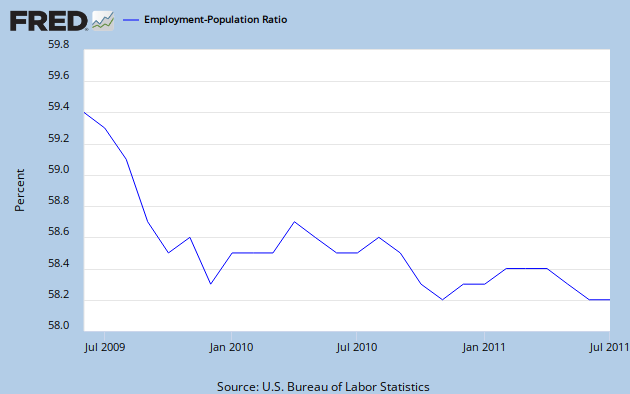
The FOMC usually tries to reach a consensus in its policy decisions. Its last meeting was an outlier, with three dissenters opposing the mild change in communications that the Fed expects economic conditions to warrant keeping short-term rates at zero through mid-2013. Unfortunately, these dissenters subscribe to what I like to call Don Quixote economics: waging war against imaginary problems while actual ones persist. Indeed, with the ten-year implied inflation at just 2% -- and falling -- worries about potential stagflation are profoundly misguided, particularly given that the civilian employment-population ratio is worsening. This bloc of self-styled inflation hawks have succeeded in stymieing more expansionary policy, only relenting when inflation expectations fall below the Fed's tacit 2% target -- which, thankfully, averts complete collapse, but regrettably does little to promote robust recovery.


Two more dovish votes on the FOMC would obviously give Bernanke more latitude to push for unconventional policies, without having to worry as much about losing a vote to the inflation hawk camp. And clearly, the case for further monetary easing is made more urgent by Congressional Republicans not only blocking further fiscal stimulus, but also actually pushing for mild austerity. 

Of course, Obama could end this confirmation charade, if he wanted to. Indeed, I just want to say two words to the president, just two words: recess appointments. Senate Republicans have, predictably, attempted to prevent Obama from even going this route by holding pro forma sessions every three days during their recess, but as Think Progress points out, this is a legally dubious tactic. In a similar case in 2004, the Eleventh Circuit court ruled that there is no minimum time Congress must be out of session before the President can use a recess appointment. So why isn't Obama filling the vacancies on the Fed that urgently need to be filled?

There are no good reasons. The most plausible is that Obama is wary of appearing too partisan and damaging his brand as the most reasonable person inside the Beltway. This is a mistake. The only issue voters know less about than the FOMC itself is how its members are appointed. Republicans might score a few political points on Obama's "overreach" for a news cycle or two, but 14 months from now that will be irrelevant. What will be relevant is the state of the economy -- and with fiscal policy on the sidelines, the Fed is the last, best chance of generating faster growth.

Obama's re-election chances could very well hinge on whether he gets religion on monetary policy. Does anybody in the White House realize this?

Wednesday, August 3, 2011

Democrats In Denial

When it comes to President Obama, liberals can't seem to get past the first stage of grief. It's one part cognitive dissonance, another part rationalization.

Liberals look at Obama and see an incontrovertibly intelligent man. And yet, he seems unable to discern the most basic political realities -- obviously a problem for a politician. Indeed, this latest exercise in Republican hostage-taking was so predictable -- to everyone but the White House, that is -- that reporter Marc Ambinder predicted it last December. At the time, Ambinder asked Obama why he had not included a debt ceiling increase in the agreement to extend the Bush tax cuts, given that the GOP would undoubtedly use the debt ceiling as leverage to extract future cuts. Obama was oblivious.

What is going on here? After all, it's no secret that the Republicans have just two overarching goals: 1) knee-capping Obama's presidency, and 2) keeping taxes on the rich low. The GOP has been quite explicit about both these aims. How could Republican intransigence still be such a shock to Obama after two and a half years of unprecedented obstructionism and extortion? Liberals alternate between hoping that Obama's weak negotiating is either some kind of still obscure rope-a-dope scheme -- "jujitsu" or "11-dimensional chess" -- or that he will finally draw the proverbial line in the sand and stand up to the Republicans.

The truth is more depressing. The only principle Obama is unwilling to compromise on is compromise itself. He values process over policy. This pose as the most reasonable man in the room might not be a problem if the other side was negotiating in good faith. They are not. Rather, their midterm rout has emboldened the GOP to take hostages. They threaten economic ruin unless their policy demands are met. And they keep doing so for a simple reason: it has worked thus far.

This is where rationalization comes in. Taken individually, none of the deals the Republicans have dictated to Obama have been that bad. The Bush tax cuts extension included a dose of stimulus in a payroll tax holiday and extended unemployment insurance. The threat of a government shutdown in April did not lead to draconian spending cuts. Neither did the brouhaha over the debt ceiling: $21 billion in FY2012 cuts will not affect Obama's electoral fate. It could have been much worse (how's that for a re-election slogan?). But that completely misses the point.

The GOP strategy is cuts by a thousand cuts. Each time they take a hostage, the Republicans wrest modest enough concessions that the Democrats give in rather than risk economic calamity over such relatively small stakes. Insofar as chipping away at the deficit has burnished Obama's centrist credentials, there's a defensible argument that he is winning the -- wait for it! -- future by mollifying independents on spending. Messaging trumps policy, too. Again, a rationalization. The reality is that the economy is far, far more important than political framing. James Carville had it right. Even an overgenerous interpretation of these deals as tactical victories for Obama adds up to a strategic defeat. The Republicans have taken stimulus off the table -- and Obama can't even blame them for it, given his cooperation and pro-austerity rhetoric. A belated "pivot" towards jobs, which Obama laughably thinks could pass the House, would hardly make a dent in our jobs crisis even if it somehow did get enough Republican support.

Still, liberals hope. They have already turned their attention to what figures to be the next political brawl: the expiration of the Bush tax cuts in late 2012. The New Republic's Jonathan Chait has been pounding the table for Obama to call the GOP's bluff, and veto any bill that keeps the Bush tax cuts for incomes above $250,000. This is politics worthy of the jujitsu moniker. It simultaneously places the blame for a middle class tax hike on the Republicans, while raising the revenue necessary to keep Social Security and Medicare close to their current forms. So, does Chait expect Obama to adopt this strategy?
The problem, though, is that we can't be sure Obama really intends to draw that line. There's a limit to how much faith one can place in a man who has so badly misjudged his political opponents time and time again. The debt ceiling ransom may be a shrewd strategic retreat, or it may be the largest in a series of historic capitulations. We won't know until the fight over the Bush tax cuts has been settled.
Unfortunately, we likely already know. Indeed, Obama's abortive attempts at a "grand bargain" during the debt ceiling negotiations included offers of tax reform, i.e. lowering rates and closing loopholes. It's certainly true that this offer was made in the context of larger negotiations, but Treasury Secretary Tim Geithner's recent op-ed still endorsing the idea should erase all doubt about the administration's intentions.

Democrats need to realize Obama cares more about appeasing the Washington Post editorial board than he does his own base. Instead of hoping that he will become the politician they want him to be, they should try to pressure him to do so. It's time to recognize he's not the one we were waiting for.

Friday, September 10, 2010

Uh Oh: Kevin Hassett Likes Obama's Business Tax Credit Proposal

How do I know Obama's proposed business investment tax credit won't do much to stimulate the economy? Kevin "DOW 36,000" Hassett thinks it's a great idea.

Indeed, Hassett makes quite the case for this latest round of giveaways to Corporate America growth-oriented tax policy:
Because the benefit of expensing depends on the time value of money and interest rates are currently quite low, one might think that expensing would have a small effect now. Nevertheless, all but the most prominent firms have to pay interest rates that are much higher than Treasury rates today when they borrow.
Actually, Hassett had it right the first time. This latest measure won't do much. Just ask incoming CEA chair Austan Goolsbee, whose academic work included looking at such tax credits:
Econometric research has commonly found that tax policy and the cost of capital have little effect on real investment. [...] For policy makers interested in using tax policy to stimulate investment or, especially, to smooth business cycle fluctuations, the results are not promising.
Which makes you wonder, who exactly is telling Obama this is good economic policy? Or (more likely) is this just a ploy to appear less "anti-business" with midterm season in full swing?