Showing posts with label Stimulus. Show all posts

Thursday, August 25, 2011

Behavioral Economics, Tax Cuts, and the Stimulus

Did the Obama administration outsmart itself when it came to the tax cuts in the 2009 stimulus?

Recall that the debate at the time centered on how much of the recovery act would be composed of spending programs versus tax cuts. Liberals argued that the ARRA should have been weighted more towards government spending, such as infrastructure, because it was more stimulative than tax cuts that would likely be saved instead of spent. However, a combination of practical (a dearth of shovel-ready projects) and political (wooing enough moderate Republicans to break the filibuster) concerns ultimately led to roughly 37% of the stimulus coming in tax cuts -- but there was a twist.

Tapping the insights of behavioral economics, the Obama administration tried to structure the tax rebates such that households would be more likely to spend them. Here is James Surowiecki explicating this strategy:
You might think that handing people a big chunk of change is a perfect way to get them to spend it. But it isn’t, because people don’t treat all windfalls as found money. Instead, in the words of the behavioral economist Richard Thaler, people put different windfalls in different “mental accounts,” which in turn influences what they do with the money. [....] 
The key factor in these kinds of distinctions, Thaler’s work suggests, is whether people think of a windfall as wealth or as income. If they think of it as wealth, they’re more likely to save it, and if they think of it as income they’re more likely to spend it. [....] 
So what does this mean for making a rebate work? If you want people to spend the money, you don’t want to give them one big check, because that makes it more likely that they’ll think of it as an increase in their wealth and save it. Instead, you want to give them small amounts over time. And you want the rebate to show up as an increase in people’s take-home pay, because an increase in steady income is more likely to translate into an increase in spending. What can accomplish both of these goals? Reducing people’s withholding payments.
Unfortunately, this may have been too clever by half. Politically, designing a tax cut so that households will not notice they are receiving it was a predictable disaster. Indeed, shortly before the 2010 midterm elections, polls showed that only one in ten respondents knew that Obama had actually reduced taxes for 95% of Americans. But there is an argument that this was perhaps a misguided economic policy as well.

One interpretation of our economic malaise is that we are still suffering from a debt overhang among households. The nominal shock of the housing bubble collapsing left many households underwater on their mortgages, and consequently drove them to begin paying down debt. Even with short-term interest rates parked up against the zero bound, there is a dearth of borrowers among households -- which also depresses business investment, since there are not as many profitable opportunities in an environment where consumers are retrenching. This economic weakness will persist until the private sector is finished deleveraging. The best the government can do is to simply avert complete collapse by borrowing the excess of desired savings over investment. This is Richard Koo's theory of the "balance sheet recession" (there is a counter-argument that if the Fed embraced more unconventional policies, it could stabilize nominal spending and end the slump, but that is for another post).

The data on household debt certainly supports the view that this time, the recession really is different. Indeed, for the first time in the post-war period, households have actually begun reducing the amount of debt on their balance sheets.
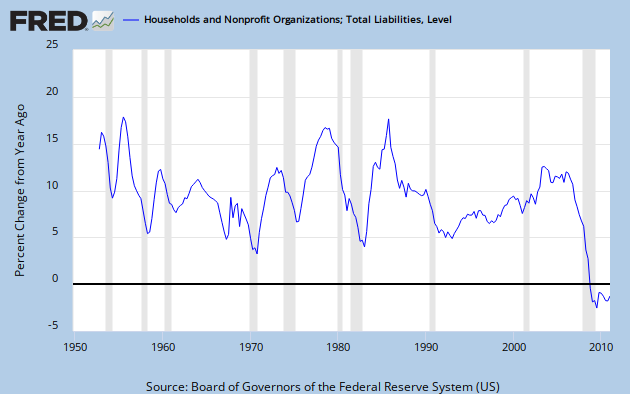

If the balance sheet recession view of our slump is correct, however, doesn't that suggest that it is better for households to save tax cuts rather than to spend them? Indeed, if growth will remain subpar as long as the private sector is deleveraging, then the quickest way to get past subpar growth is to accelerate the deleveraging process. There are three strategies for doing so. First, policymakers could simply write down the value of underwater mortgages to their current face value -- but this would necessitate recapitalizing banks as well, which is an obvious political non-starter. Second, the Federal Reserve could try to engineer above-trend inflation over the short-term to erode the real value of debts. Unfortunately, there is little support among the FOMC for such a proposition (not to mention that successfully orchestrating higher inflation would probably require such radical policies that even the most dovish FOMC members would be reluctant to try).

That leaves tax rebates. At the risk of sounding tautological, giving households money to pay down debts obviously speeds up the process of paying down those debts. The sums involved from the ARRA were not very large -- $400 for single-earner households; $800 for couples -- but the notion that it would have been a "waste" if households did not spend those checks misses the point of the balance sheet recession. Sending out lump sum tax rebates might have been the more efficient policy over the longer-term, since that presumably would have led to households putting themselves on firmer financial footing faster than they otherwise did.

To be sure, the government needed to spend money to provide a stream of income to the private sector so that it could save. But the Obama administration might have been better served thinking of the tax cuts as a means to hasten the rebuilding of household balance sheets, and of public spending as a means to set a floor under the economy, rather than conceiving of both as the latter.

The great irony is that an unconventional recession perhaps called for a conventional response on taxes.

Friday, August 19, 2011

The Limits of Keynesianism?

Is an age of austerity unavoidable? That is the question James McDonald asks in a thought-provoking piece that outlines the policy response to the financial crisis, and the problems that high levels of private debt pose to recovery.

Felix Salmon approvingly flags down this passage:
The markets have highlighted a fundamental shortcoming in Keynes' ideas: He assumed that governments would always be able to borrow. If they cannot, then Keynesian economics is dead in the water.
It is worth considering why a government might find itself unable to borrow in the private markets. Consider the examples McDonald cites: the PIIGS. Here is McDonald on Europe's seemingly atypical debt crisis:
Indeed, one of the most striking aspects of the eurozone crisis is that bond markets have not discriminated between causes of excessive debt.... What we are seeing, in other words, is a wholesale revision of the rules about debt that have held true for decades.
It is certainly true that the PIIGS evoke Tolstoy's description of unhappy families, but do their mutual yet disparate problems really portend a dramatic break with the rules that have governed debt in the post-war period? After all, McDonald omits the most salient point: all of the PIIGS are members of the Euro. It should not surprise us that a fixed exchange rate system calls the debts of high debt and low growth countries into question. By forfeiting monetary sovereignty, the PIIGS were left vulnerable to nominal shocks -- such as the financial crisis -- without the usual buffers of monetary easing or devaluing. Like the Gold Standard in the 1930s, the Euro has forced the PIIGS to adopt deflationary policies at precisely the wrong moment. Unfortunately, austerity is self-defeating here since it depresses growth; the denominator of the debt-to-GDP ratio shrinks in tandem with the numerator. This is Fisher's debt deflation on a sovereign level.

Fixed exchange rate systems merely substitute default risk for exchange rate risk. Debts that would otherwise be sustainable suddenly catch the ire of bond vigilantes who (legitimately) doubt the prospects for growth under the exchange rate regime. The same was true, of course, for Argentina in 2002 -- although in that case the culprit was not monetary union, but rather a currency peg. Insofar as this offers any lessons about the supposed practical limits of Keynesian stimulus, it would seem to be: do not surrender monetary sovereignty by joining a fixed exchange rate system.

There is another way for a government to get shut out of the bond markets: high inflation. If a country's central bank lacks credibility in promoting price stability and inflation reaches some critical point, private lenders will demand prohibitively high interest rates. Of course, this risks spiraling out of control: the inability to finance deficits in the international markets creates the temptation to monetize them instead. Inflation accelerates, making bond markets even more wary of lending money. In the worst case, this ends with Zimbabwe-style hyperinflation. But given that most advanced economies are still stuck in a liquidity trap, this is not terribly relevant right now.

As long as a country remains in the Goldilocks territory of controlling its own currency (especially if it can denominate debt in that currency) without letting inflation run too high, it should be able to engage in counter-cyclical Keynesian policy. Indeed, Salmon notes that the U.S. can happily still borrow at historically low rates, although the political winds are blowing the other way towards fiscal consolidation. But then comes this somewhat puzzling passage:
[W]e’re in the final innings of the Keynesian game. If you look at the history of sovereign debt, we started with countries borrowing large sums of money from rich private-sector individuals like the Rothschilds. When those sums weren’t enough, the era of big publicly-owned banks began, and borrowing capacity rose sharply. Then we moved into domestic capital markets, and eventually international capital markets. Each move increased the amount of money available for lending to sovereigns. Finally, when sovereigns get tapped out, they can try to appeal to super-sovereigns: the ECB, the EFSF, the IMF and the like. But those funds are limited, and don’t last long. Hence the move to austerity — the only other option.
The problem is not a dearth of private capital willing to lend to sovereigns; the problem is the lack of growth prospects for the PIIGS makes private capital unwilling to lend to them at affordable rates due to worries about eventual default. Hence, the necessary interventions of the ECB, EFSF, and the IMF. The irony is that we still suffer from a surfeit of savings: China et. al. have trade surpluses to recycle, and increased savings in the West are still eagerly seeking safe, liquid investments. That the 10-year Treasury bond recently yielded less than two percent and gilts touched lows not seen since the 1890s shows that the markets are desperate for debt from sovereigns that can credibly promise NGDP growth.

If the "Keynesian game" is indeed over, it is because of the misguided choices of politicians in countries that can still borrow to pursue austerity instead, while the PIIGS suffer under a renewed version of that old barbarous relic. And that is what makes this all so tragic. With a little bit of clear thinking and political will, a double dip would be preventable. Alas, we seem determined to forget our history.

Friday, September 10, 2010

Uh Oh: Kevin Hassett Likes Obama's Business Tax Credit Proposal

How do I know Obama's proposed business investment tax credit won't do much to stimulate the economy? Kevin "DOW 36,000" Hassett thinks it's a great idea.

Indeed, Hassett makes quite the case for this latest round of giveaways to Corporate America growth-oriented tax policy:
Because the benefit of expensing depends on the time value of money and interest rates are currently quite low, one might think that expensing would have a small effect now. Nevertheless, all but the most prominent firms have to pay interest rates that are much higher than Treasury rates today when they borrow.
Actually, Hassett had it right the first time. This latest measure won't do much. Just ask incoming CEA chair Austan Goolsbee, whose academic work included looking at such tax credits:
Econometric research has commonly found that tax policy and the cost of capital have little effect on real investment. [...] For policy makers interested in using tax policy to stimulate investment or, especially, to smooth business cycle fluctuations, the results are not promising.
Which makes you wonder, who exactly is telling Obama this is good economic policy? Or (more likely) is this just a ploy to appear less "anti-business" with midterm season in full swing?