Saturday, August 20, 2011

Why Does John Mauldin Still Hate QE2?

John Mauldin has a sixth sense: he sees stagflation. Everywhere. Hence, his vociferous opposition to QE2. Never mind that the Fed was undershooting its tacit 2% inflation target back in August 2010 with implied ten-year inflation at 1.5% -- John Mauldin just knows that further monetary easing means the 1970s are right around the corner. And has apparently never heard of interest on excess reserves.

Mauldin recently reiterated his antipathy to QE2 with a substantive defense of Rick Perry calling Ben Bernanke "treasonous", while, of course, disavowing the Texas governor's belligerent tone. This is neither unexpected nor interesting. What is interesting is the chart Mauldin produces in the same note that purports to signal when the economy is entering recession. Compiling Fed surveys, along with a host of national economic indicators, Mauldin shows that recession warning signs are currently flashing bright red -- and that QE1 and QE2 not only turned things around before, but that their conclusion marked the beginning of economic weakening.


Simultaneously believing in this chart's predictive value and that QE2 was an unwise policy would seem to require a Herculean display of cognitive dissonance. Unless Mauldin simply subscribes to Mellon-esque liquidationism.

Still, it would be edifying if Mauldin would acknowledge the apparent tradeoff between 2-4% inflation and complete economic collapse, rather than ranting about the imminent return of problems that do not plague us. If we are to get past this muddle, we must cast aside Don Quixote economics.

Friday, August 19, 2011

The Limits of Keynesianism?

Is an age of austerity unavoidable? That is the question James McDonald asks in a thought-provoking piece that outlines the policy response to the financial crisis, and the problems that high levels of private debt pose to recovery.

Felix Salmon approvingly flags down this passage:
The markets have highlighted a fundamental shortcoming in Keynes' ideas: He assumed that governments would always be able to borrow. If they cannot, then Keynesian economics is dead in the water.
It is worth considering why a government might find itself unable to borrow in the private markets. Consider the examples McDonald cites: the PIIGS. Here is McDonald on Europe's seemingly atypical debt crisis:
Indeed, one of the most striking aspects of the eurozone crisis is that bond markets have not discriminated between causes of excessive debt.... What we are seeing, in other words, is a wholesale revision of the rules about debt that have held true for decades.
It is certainly true that the PIIGS evoke Tolstoy's description of unhappy families, but do their mutual yet disparate problems really portend a dramatic break with the rules that have governed debt in the post-war period? After all, McDonald omits the most salient point: all of the PIIGS are members of the Euro. It should not surprise us that a fixed exchange rate system calls the debts of high debt and low growth countries into question. By forfeiting monetary sovereignty, the PIIGS were left vulnerable to nominal shocks -- such as the financial crisis -- without the usual buffers of monetary easing or devaluing. Like the Gold Standard in the 1930s, the Euro has forced the PIIGS to adopt deflationary policies at precisely the wrong moment. Unfortunately, austerity is self-defeating here since it depresses growth; the denominator of the debt-to-GDP ratio shrinks in tandem with the numerator. This is Fisher's debt deflation on a sovereign level.

Fixed exchange rate systems merely substitute default risk for exchange rate risk. Debts that would otherwise be sustainable suddenly catch the ire of bond vigilantes who (legitimately) doubt the prospects for growth under the exchange rate regime. The same was true, of course, for Argentina in 2002 -- although in that case the culprit was not monetary union, but rather a currency peg. Insofar as this offers any lessons about the supposed practical limits of Keynesian stimulus, it would seem to be: do not surrender monetary sovereignty by joining a fixed exchange rate system.

There is another way for a government to get shut out of the bond markets: high inflation. If a country's central bank lacks credibility in promoting price stability and inflation reaches some critical point, private lenders will demand prohibitively high interest rates. Of course, this risks spiraling out of control: the inability to finance deficits in the international markets creates the temptation to monetize them instead. Inflation accelerates, making bond markets even more wary of lending money. In the worst case, this ends with Zimbabwe-style hyperinflation. But given that most advanced economies are still stuck in a liquidity trap, this is not terribly relevant right now.

As long as a country remains in the Goldilocks territory of controlling its own currency (especially if it can denominate debt in that currency) without letting inflation run too high, it should be able to engage in counter-cyclical Keynesian policy. Indeed, Salmon notes that the U.S. can happily still borrow at historically low rates, although the political winds are blowing the other way towards fiscal consolidation. But then comes this somewhat puzzling passage:
[W]e’re in the final innings of the Keynesian game. If you look at the history of sovereign debt, we started with countries borrowing large sums of money from rich private-sector individuals like the Rothschilds. When those sums weren’t enough, the era of big publicly-owned banks began, and borrowing capacity rose sharply. Then we moved into domestic capital markets, and eventually international capital markets. Each move increased the amount of money available for lending to sovereigns. Finally, when sovereigns get tapped out, they can try to appeal to super-sovereigns: the ECB, the EFSF, the IMF and the like. But those funds are limited, and don’t last long. Hence the move to austerity — the only other option.
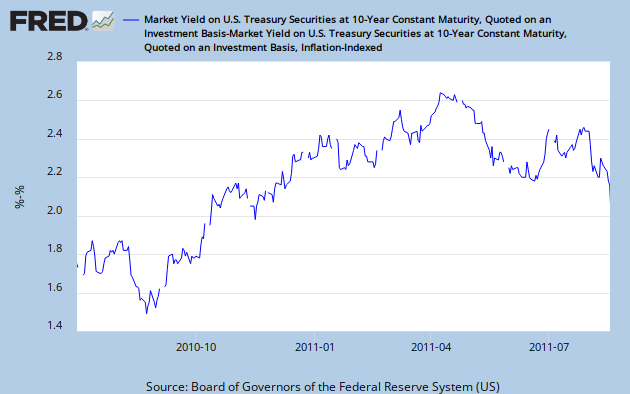
The problem is not a dearth of private capital willing to lend to sovereigns; the problem is the lack of growth prospects for the PIIGS makes private capital unwilling to lend to them at affordable rates due to worries about eventual default. Hence, the necessary interventions of the ECB, EFSF, and the IMF. The irony is that we still suffer from a surfeit of savings: China et. al. have trade surpluses to recycle, and increased savings in the West are still eagerly seeking safe, liquid investments. That the 10-year Treasury bond recently yielded less than two percent and gilts touched lows not seen since the 1890s shows that the markets are desperate for debt from sovereigns that can credibly promise NGDP growth.

If the "Keynesian game" is indeed over, it is because of the misguided choices of politicians in countries that can still borrow to pursue austerity instead, while the PIIGS suffer under a renewed version of that old barbarous relic. And that is what makes this all so tragic. With a little bit of clear thinking and political will, a double dip would be preventable. Alas, we seem determined to forget our history.

The Most Specious Tax Argument Ever

Conservatives are in a tizzy because Warren Buffett had the temerity to once again suggest that he should pay a higher percentage of his income in taxes than his secretary does. The gall!

The GOP response has been as predictable as it is unpersuasive: Buffett is a hypocrite for not promoting a wealth tax instead, and just wants to keep the merely rich from reaching his status; the armies of lawyers and accountants the super-rich employ will insulate them from any tax hikes; and, if Buffett wants to pay higher taxes, why not just do it himself?

But Investors Business Daily wins the award for chutzpah with their Orwellian argument that the tax burden for top earners has actually increased in the last decade:
Nor is it true, as Buffett claims, that the rich have been "coddled." Indeed, the top 0.1% of income earners — the millionaires and billionaires Buffett says have made out like bandits — paid a third more in federal income taxes in 2008 than they did in 2001. 
The richest 400 paid almost two-thirds more. And the share of federal income taxes paid by the rich climbed after the Bush tax cuts went into effect.
There's a lot of dishonesty to unpack here. First, comparing absolute tax returns -- the metric they cite -- is essentially meaningless. The reductio ad absurdum version of this argument is that since the richest 0.1% paid more in taxes in nominal dollars in 2008 than they did in 1954 -- when top marginal rates were 91% -- that the rich are taxed more heavily now than then. Clearly, this tells us nothing. Between inflation and rising real incomes (at least for the top of the income distribution) this is what we would expect; higher nominal incomes should translate to higher nominal tax returns. The same is true for the 2008 versus 2001 comparison, albeit to a much lesser degree.

Let's inject some facts into this debate, courtesy of Emmanuel Saez. In 2001, the top 0.1% of earners accounted for 8.37% of all income and took home an average of $4.58 million (in 2008 dollars); in 2008 the top 0.1% of earners accounted for 10.4% of all income and took home an average of $5.65 million (in 2008 dollars). That amounts to a 23% increase in real incomes over eight years. What explains this prodigious jump? The top 0.1% of earners derive a large proportion of their income from capital gains, so they are more sensitive than most to the markets. In other words, their incomes are more pro-cyclical than those of a typical worker. The tech bubble wiped out a large chunk of wealth for the top 0.1% in 2001, which the housing bubble promptly restored in 2008 (tax returns for 2008 came in before Lehman went bust, so even though markets were off their October 2007 highs, they had not fallen too far).

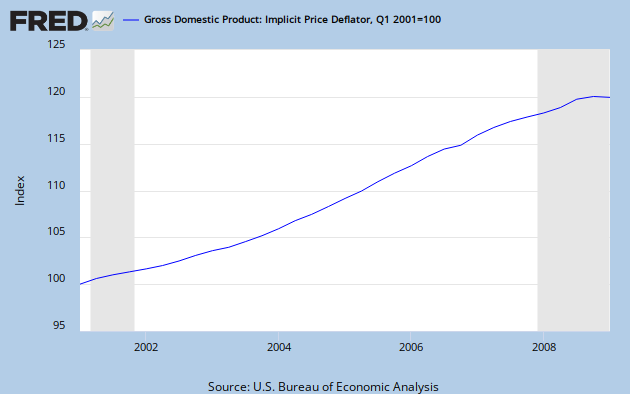
It gets worse. The price level increased roughly 20% between 2001 and 2008. Factoring that rise in with the 23% bump in real incomes for the top 0.1% gives them a 48% increase in nominal incomes over the period. Remember how the top 0.1% paying 33% more in taxes in 2008 than in 2001 was supposed to prove how they hadn't been "coddled"? Oops. The same, of course, applies to the top 400 tax filers. The IRS data clearly shows that the effective tax rate for the top 400 filers fell significantly between 2001 and 2008.

Investors Business Daily does manage to get one fact right. The share of federal incomes taxes paid by the rich has increased since the Bush tax cuts became law. But that merely reflects the reality that increasing numbers of households are simply too poor to pay much after accounting for state, local and payroll taxes -- the last of which is regressive and raised 97% of the revenue that federal income taxes did in 2009.

Conservatives react to the undeniable reality that the richest members of our society benefit from egregious loopholes like carried interest with the equivalent of a temper tantrum. They know the wealthy are taxed too much, facts be damned! No, increasing taxes on the super-rich will not come close to filling our structural deficit, but it would not be insignificant either: perhaps $1 trillion over a decade. And it would go a long way towards reducing the blatant unfairness in our tax code.

The most specious tax argument ever does not change this.

Wednesday, August 17, 2011

Does Alan Blinder Want to End the Liquidity Trap?

Some rather puzzling comments from former Fed Vice Chairman Alan Blinder. Here is what Blinder had to say about the Fed's recent statement that it anticipates keeping short-term rates near zero through mid-2013:
In doing so, the Fed violated one of the most revered canons of central banking: Always keep your options open. No one knows what might happen between now and June 2013 -- not you, not me, and not the FOMC. A booming economy by, say, Christmas 2012 doesn't look too likely right now, but it could happen. And if it does, the Fed won't want to keep the federal-funds rate near zero. So why risk the loss of credibility?  
The answer is that the FOMC was so concerned about the health of our economy that they felt they had a duty to offer some support some support to the frail economy and soothe the nearly panicked financial markets. But they had used up all their good ammunition long ago.
While it is undoubtedly true that monetary policy is more difficult at the zero bound, that does not mean the Fed is out of proverbial bullets. Indeed, the Fed could still announce an interest rate target for 10-year bonds that would amount to open-ended QE3. Or the Fed could start buying other assets. Eliminating interest on excess reserves is another possibility. There are options.

But the most perplexing aspect of Blinder's piece is his attitude towards the Fed's change in communications. The Fed didn't actually say what Blinder says it did. And that's too bad. The Fed only said that it expects short-term rates to stay parked near the zero bound till mid-2013; it did not promise to keep them there. Here is the relevant passage from the latest FOMC statement:
The Committee currently anticipates that economic conditions--including low rates of resource utilization and a subdued outlook for inflation over the medium run--are likely to warrant exceptionally low levels for the federal funds rate at least through mid-2013.
This is certainly a more dovish statement, but it is not a commitment: it is making the Fed's own economic forecasts more transparent. If growth suddenly picked up around Christmas 2012, as Blinder imagines, nothing in this statement would preclude the Fed from hiking rates to check inflation. That's a problem.

Absent an explicit level target, a period of "responsible irresponsibility" is perhaps the Fed's best tactic for getting the economy out of a liquidity trap. After all, if markets think the Fed will react to any future above-trend inflation by raising rates, inflation expectations today will remain subdued -- and the economy will stay stuck. As Paul Krugman first suggested and Eggertsson and Woodford later expanded on, the reverse is true as well. If central banks credibly commit to maintaining expansionary policies for a prolonged period -- presumably longer than warranted -- then future inflation expectations should rise, causing real interest rates to fall and demand to pick up. Blinder's concern about the Fed boxing itself in to low rates ill-suited for future conditions is precisely the point of the policy.

Unfortunately, as long as economists remain more concerned with maintaining the Fed's future credibility as an inflation-fighter than with the devastating consequences of long-term unemployment, we will not get out of this muddle. We have enough real problems that we do not need to invent new ones.

Monday, August 15, 2011

What HFT Hedge Funds Tell Us About Carried Interest

Warren Buffett's recent New York Times op-ed calling for higher taxes on the super-rich has brought the issue of carried interest back into relief.  For the uninitiated, carried interest is the tax loophole that lets private partnerships -- venture capitalists along with private equity, hedge fund and real estate managers -- get taxed at the long-term capital gains rate rather than at the ordinary income rate. That is why a billionaire fund manager like Buffett recently had a tax bill that amounted to only 17.4% of his income.

Carried interest is actually a bit more complicated. Members of private partnerships are typically compensated along a 2/20 model: they earn a management fee equal to 2% of the size of their fund, and receive a performance fee of 20% of any profits. The 2% management fee is taxed at the ordinary income rate -- i.e., 35% -- but the 20% of profits are taxed at the capital gains rate of 15%, despite the fact that fund managers ordinarily do not risk much of their own capital. There's a final wrinkle. Managers must hold on to a position for a year to qualify for the long-term capitals gain rate of 15%; if they do not, profits are taxed as ordinary income.

Megan McArdle considers these facts and lays out her strongest counter-argument for maintaining the carried interest exemption:
The arguments for the carried interest are farily compelling: without it, the partners who contributed ideas and talent end up being taxed much more heavily on their earnings than partners who contributed financial assets. This is not only sort of unfair, and impedes the ability of talented people with few financial resources to move into the moneyed class, but also might have implications for economic growth: if your gains are going to be taxed at ordinary income rates, why quit that safe job and risk all on an untried venture?
Short answer: because the returns on these "untried ventures" are the most lucrative in our society. It's difficult to imagine someone choosing not to work at a private equity fund because carried interest was eliminated, given that it would be nearly impossible to find an equally well-paying job (none of which would enjoy tax subsidies either). Indeed, McArdle herself reaches the same conclusion -- albeit, rather tentatively.

But this is less a hypothetical question than an empirical one. Consider the case of high-frequency trading (HFT) hedge funds. As previously mentioned, a fund must hold a position for one year to qualify for the 15% capital gains rate. Venture capital, private equity and real estate trusts make multi-year investments, so this does not affect them. But many hedge funds, particularly the automated HFT crowd, hold very short-term positions. Consequently, those hedge funds have their entire income taxed at the ordinary rate. This has not seemed to much affect their staffing. Indeed, if there have been stories about HFT hedge funds having trouble hiring due to prospective employees worrying about their tax statuses, I have certainly missed them.

The proliferation of HFT funds the past few years shows that the marginal supply of hedge funders is relatively inelastic to the carried interest loophole, due to the inability to substitute a higher-paying job. Pretending otherwise is simply searching for a justification for an unjustifiable policy.

Saturday, August 13, 2011

The Don Quixote Economics of the Fed Dissenters

Aside from rumblings in Richard Fisher's gut, what are the best arguments Fed dissenters have against further easing? Here's Minneapolis Fed governor Narayana Kocherlakota giving his rationale for opposing the recent change in the Fed's communication strategy:


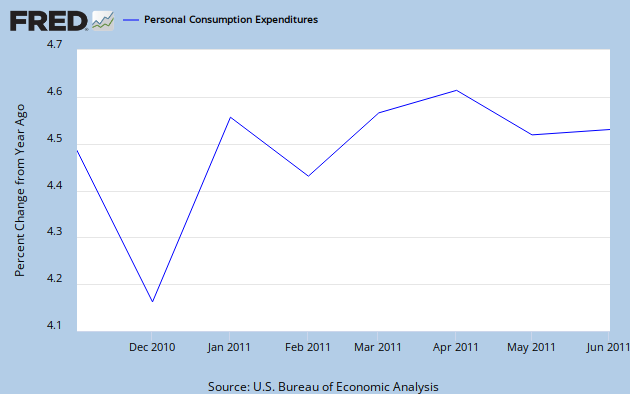
How about a reality check. Let's take a look at the percent change in PCE from the previous year, starting in November 2010.


See the "notable rise" in PCE inflation? Try squinting. Of course, Kocherlakota hedges a bit by claiming that the increase occurred during the first half of 2011, which conveniently ignores the subsequent decline (both of which were mainly driven by oil prices). The argument that PCE minus food and gas prices have also increased is equally hyperbolic -- unless a move from 1% to 1.3% inflation is worrisome.

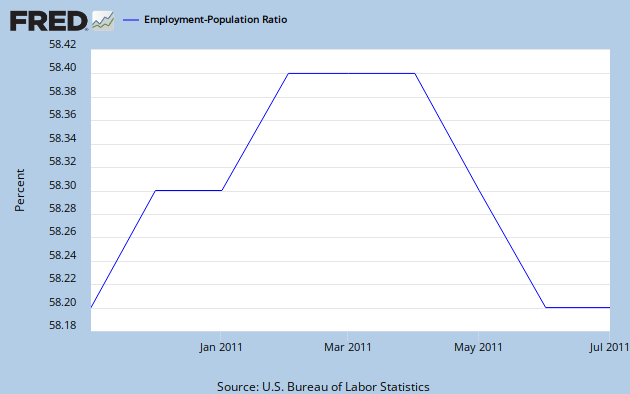
What about unemployment? Given that it has come down from 9.8% in November 2010 to 9.1% in July 2011, perhaps further action is unwarranted. Unfortunately, this statistic is misleading. The U3 measure of unemployment ignores discouraged workers; the civilian employment-population ratio gives us a more accurate assessment of the labor market.


See the fall in unemployment now? If the economy is not already back in recession, it is certainly stuck in a "growth recession", where not enough jobs are being created to keep up with population growth. The output gap is steadily widening.

Confronted with subdued inflation expectations and a deteriorating jobs market, the Fed dissenters insist that the reverse is true. This is Don Quixote economics: waging war on imaginary problems while real ones persist unabated. It reflects little more than irrational angst over unconventional monetary policy, coupled with a misplaced conviction that any uptick in inflation augurs the return of stagflation. Regrettably, empirical evidence will not convince the inflation hawks that it is not 1980, nor will the continuing jobs crisis move them to act. As long as inflation runs between 1-2%, they consider it mission accomplished.

Meanwhile, the economy is falling even further below its long-term trend.

Thursday, August 11, 2011

Austerity Doom Loop

The preoccupation with deficits and (nonexistent) inflation by policymakers on both sides of the Atlantic is short-circuiting the recovery, such as it was.

Even more troubling is the possibility that Very Serious People will interpret their policy failures as a sign that spending cuts have simply not gone far enough -- an austerity doom loop. It goes something like this:

1. Look at those deficits! We have to cut spending or the bond vigilantes will go Galt on us! (never mind that they are more than happy to lend to us at historically low rates).
2. Spending cuts lower growth expectations.
3. Investors pile into government debt in a flight to safety.
4. Austerians claim lower yields vindicate their agenda. Confidence has been restored!
5. Unemployment does not come down. Deficits worsen.
6. Repeat.

The market for ideas, like others, is not necessarily self-correcting. Which is why it would be helpful if President Obama -- who should know better -- would stop parroting GOP talking points about deficits and the confidence fairy.