Friday, August 19, 2011

The Most Specious Tax Argument Ever

Conservatives are in a tizzy because Warren Buffett had the temerity to once again suggest that he should pay a higher percentage of his income in taxes than his secretary does. The gall!

The GOP response has been as predictable as it is unpersuasive: Buffett is a hypocrite for not promoting a wealth tax instead, and just wants to keep the merely rich from reaching his status; the armies of lawyers and accountants the super-rich employ will insulate them from any tax hikes; and, if Buffett wants to pay higher taxes, why not just do it himself?

But Investors Business Daily wins the award for chutzpah with their Orwellian argument that the tax burden for top earners has actually increased in the last decade:
Nor is it true, as Buffett claims, that the rich have been "coddled." Indeed, the top 0.1% of income earners — the millionaires and billionaires Buffett says have made out like bandits — paid a third more in federal income taxes in 2008 than they did in 2001. 
The richest 400 paid almost two-thirds more. And the share of federal income taxes paid by the rich climbed after the Bush tax cuts went into effect.
There's a lot of dishonesty to unpack here. First, comparing absolute tax returns -- the metric they cite -- is essentially meaningless. The reductio ad absurdum version of this argument is that since the richest 0.1% paid more in taxes in nominal dollars in 2008 than they did in 1954 -- when top marginal rates were 91% -- that the rich are taxed more heavily now than then. Clearly, this tells us nothing. Between inflation and rising real incomes (at least for the top of the income distribution) this is what we would expect; higher nominal incomes should translate to higher nominal tax returns. The same is true for the 2008 versus 2001 comparison, albeit to a much lesser degree.

Let's inject some facts into this debate, courtesy of Emmanuel Saez. In 2001, the top 0.1% of earners accounted for 8.37% of all income and took home an average of $4.58 million (in 2008 dollars); in 2008 the top 0.1% of earners accounted for 10.4% of all income and took home an average of $5.65 million (in 2008 dollars). That amounts to a 23% increase in real incomes over eight years. What explains this prodigious jump? The top 0.1% of earners derive a large proportion of their income from capital gains, so they are more sensitive than most to the markets. In other words, their incomes are more pro-cyclical than those of a typical worker. The tech bubble wiped out a large chunk of wealth for the top 0.1% in 2001, which the housing bubble promptly restored in 2008 (tax returns for 2008 came in before Lehman went bust, so even though markets were off their October 2007 highs, they had not fallen too far).

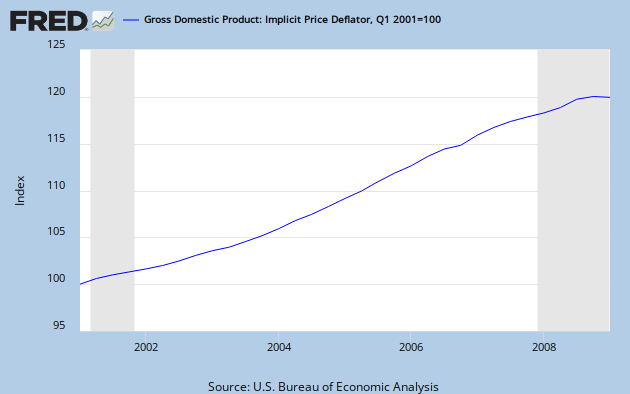
It gets worse. The price level increased roughly 20% between 2001 and 2008. Factoring that rise in with the 23% bump in real incomes for the top 0.1% gives them a 48% increase in nominal incomes over the period. Remember how the top 0.1% paying 33% more in taxes in 2008 than in 2001 was supposed to prove how they hadn't been "coddled"? Oops. The same, of course, applies to the top 400 tax filers. The IRS data clearly shows that the effective tax rate for the top 400 filers fell significantly between 2001 and 2008.

Investors Business Daily does manage to get one fact right. The share of federal incomes taxes paid by the rich has increased since the Bush tax cuts became law. But that merely reflects the reality that increasing numbers of households are simply too poor to pay much after accounting for state, local and payroll taxes -- the last of which is regressive and raised 97% of the revenue that federal income taxes did in 2009.

Conservatives react to the undeniable reality that the richest members of our society benefit from egregious loopholes like carried interest with the equivalent of a temper tantrum. They know the wealthy are taxed too much, facts be damned! No, increasing taxes on the super-rich will not come close to filling our structural deficit, but it would not be insignificant either: perhaps $1 trillion over a decade. And it would go a long way towards reducing the blatant unfairness in our tax code.

The most specious tax argument ever does not change this.

Wednesday, August 17, 2011

Does Alan Blinder Want to End the Liquidity Trap?

Some rather puzzling comments from former Fed Vice Chairman Alan Blinder. Here is what Blinder had to say about the Fed's recent statement that it anticipates keeping short-term rates near zero through mid-2013:
In doing so, the Fed violated one of the most revered canons of central banking: Always keep your options open. No one knows what might happen between now and June 2013 -- not you, not me, and not the FOMC. A booming economy by, say, Christmas 2012 doesn't look too likely right now, but it could happen. And if it does, the Fed won't want to keep the federal-funds rate near zero. So why risk the loss of credibility?  
The answer is that the FOMC was so concerned about the health of our economy that they felt they had a duty to offer some support some support to the frail economy and soothe the nearly panicked financial markets. But they had used up all their good ammunition long ago.
While it is undoubtedly true that monetary policy is more difficult at the zero bound, that does not mean the Fed is out of proverbial bullets. Indeed, the Fed could still announce an interest rate target for 10-year bonds that would amount to open-ended QE3. Or the Fed could start buying other assets. Eliminating interest on excess reserves is another possibility. There are options.

But the most perplexing aspect of Blinder's piece is his attitude towards the Fed's change in communications. The Fed didn't actually say what Blinder says it did. And that's too bad. The Fed only said that it expects short-term rates to stay parked near the zero bound till mid-2013; it did not promise to keep them there. Here is the relevant passage from the latest FOMC statement:
The Committee currently anticipates that economic conditions--including low rates of resource utilization and a subdued outlook for inflation over the medium run--are likely to warrant exceptionally low levels for the federal funds rate at least through mid-2013.
This is certainly a more dovish statement, but it is not a commitment: it is making the Fed's own economic forecasts more transparent. If growth suddenly picked up around Christmas 2012, as Blinder imagines, nothing in this statement would preclude the Fed from hiking rates to check inflation. That's a problem.

Absent an explicit level target, a period of "responsible irresponsibility" is perhaps the Fed's best tactic for getting the economy out of a liquidity trap. After all, if markets think the Fed will react to any future above-trend inflation by raising rates, inflation expectations today will remain subdued -- and the economy will stay stuck. As Paul Krugman first suggested and Eggertsson and Woodford later expanded on, the reverse is true as well. If central banks credibly commit to maintaining expansionary policies for a prolonged period -- presumably longer than warranted -- then future inflation expectations should rise, causing real interest rates to fall and demand to pick up. Blinder's concern about the Fed boxing itself in to low rates ill-suited for future conditions is precisely the point of the policy.

Unfortunately, as long as economists remain more concerned with maintaining the Fed's future credibility as an inflation-fighter than with the devastating consequences of long-term unemployment, we will not get out of this muddle. We have enough real problems that we do not need to invent new ones.

Monday, August 15, 2011

What HFT Hedge Funds Tell Us About Carried Interest

Warren Buffett's recent New York Times op-ed calling for higher taxes on the super-rich has brought the issue of carried interest back into relief.  For the uninitiated, carried interest is the tax loophole that lets private partnerships -- venture capitalists along with private equity, hedge fund and real estate managers -- get taxed at the long-term capital gains rate rather than at the ordinary income rate. That is why a billionaire fund manager like Buffett recently had a tax bill that amounted to only 17.4% of his income.

Carried interest is actually a bit more complicated. Members of private partnerships are typically compensated along a 2/20 model: they earn a management fee equal to 2% of the size of their fund, and receive a performance fee of 20% of any profits. The 2% management fee is taxed at the ordinary income rate -- i.e., 35% -- but the 20% of profits are taxed at the capital gains rate of 15%, despite the fact that fund managers ordinarily do not risk much of their own capital. There's a final wrinkle. Managers must hold on to a position for a year to qualify for the long-term capitals gain rate of 15%; if they do not, profits are taxed as ordinary income.

Megan McArdle considers these facts and lays out her strongest counter-argument for maintaining the carried interest exemption:
The arguments for the carried interest are farily compelling: without it, the partners who contributed ideas and talent end up being taxed much more heavily on their earnings than partners who contributed financial assets. This is not only sort of unfair, and impedes the ability of talented people with few financial resources to move into the moneyed class, but also might have implications for economic growth: if your gains are going to be taxed at ordinary income rates, why quit that safe job and risk all on an untried venture?
Short answer: because the returns on these "untried ventures" are the most lucrative in our society. It's difficult to imagine someone choosing not to work at a private equity fund because carried interest was eliminated, given that it would be nearly impossible to find an equally well-paying job (none of which would enjoy tax subsidies either). Indeed, McArdle herself reaches the same conclusion -- albeit, rather tentatively.

But this is less a hypothetical question than an empirical one. Consider the case of high-frequency trading (HFT) hedge funds. As previously mentioned, a fund must hold a position for one year to qualify for the 15% capital gains rate. Venture capital, private equity and real estate trusts make multi-year investments, so this does not affect them. But many hedge funds, particularly the automated HFT crowd, hold very short-term positions. Consequently, those hedge funds have their entire income taxed at the ordinary rate. This has not seemed to much affect their staffing. Indeed, if there have been stories about HFT hedge funds having trouble hiring due to prospective employees worrying about their tax statuses, I have certainly missed them.

The proliferation of HFT funds the past few years shows that the marginal supply of hedge funders is relatively inelastic to the carried interest loophole, due to the inability to substitute a higher-paying job. Pretending otherwise is simply searching for a justification for an unjustifiable policy.

Saturday, August 13, 2011

The Don Quixote Economics of the Fed Dissenters

Aside from rumblings in Richard Fisher's gut, what are the best arguments Fed dissenters have against further easing? Here's Minneapolis Fed governor Narayana Kocherlakota giving his rationale for opposing the recent change in the Fed's communication strategy:


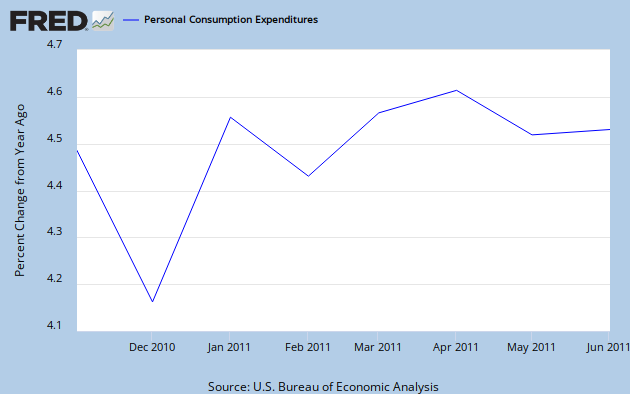
How about a reality check. Let's take a look at the percent change in PCE from the previous year, starting in November 2010.


See the "notable rise" in PCE inflation? Try squinting. Of course, Kocherlakota hedges a bit by claiming that the increase occurred during the first half of 2011, which conveniently ignores the subsequent decline (both of which were mainly driven by oil prices). The argument that PCE minus food and gas prices have also increased is equally hyperbolic -- unless a move from 1% to 1.3% inflation is worrisome.

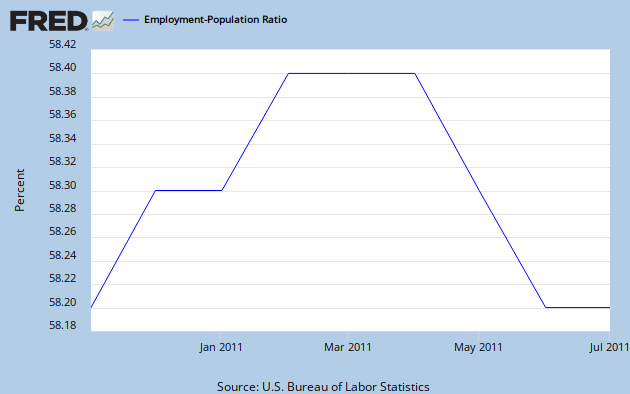
What about unemployment? Given that it has come down from 9.8% in November 2010 to 9.1% in July 2011, perhaps further action is unwarranted. Unfortunately, this statistic is misleading. The U3 measure of unemployment ignores discouraged workers; the civilian employment-population ratio gives us a more accurate assessment of the labor market.


See the fall in unemployment now? If the economy is not already back in recession, it is certainly stuck in a "growth recession", where not enough jobs are being created to keep up with population growth. The output gap is steadily widening.

Confronted with subdued inflation expectations and a deteriorating jobs market, the Fed dissenters insist that the reverse is true. This is Don Quixote economics: waging war on imaginary problems while real ones persist unabated. It reflects little more than irrational angst over unconventional monetary policy, coupled with a misplaced conviction that any uptick in inflation augurs the return of stagflation. Regrettably, empirical evidence will not convince the inflation hawks that it is not 1980, nor will the continuing jobs crisis move them to act. As long as inflation runs between 1-2%, they consider it mission accomplished.

Meanwhile, the economy is falling even further below its long-term trend.

Thursday, August 11, 2011

Austerity Doom Loop

The preoccupation with deficits and (nonexistent) inflation by policymakers on both sides of the Atlantic is short-circuiting the recovery, such as it was.

Even more troubling is the possibility that Very Serious People will interpret their policy failures as a sign that spending cuts have simply not gone far enough -- an austerity doom loop. It goes something like this:

1. Look at those deficits! We have to cut spending or the bond vigilantes will go Galt on us! (never mind that they are more than happy to lend to us at historically low rates).
2. Spending cuts lower growth expectations.
3. Investors pile into government debt in a flight to safety.
4. Austerians claim lower yields vindicate their agenda. Confidence has been restored!
5. Unemployment does not come down. Deficits worsen.
6. Repeat.

The market for ideas, like others, is not necessarily self-correcting. Which is why it would be helpful if President Obama -- who should know better -- would stop parroting GOP talking points about deficits and the confidence fairy.

Wednesday, August 3, 2011

Democrats In Denial

When it comes to President Obama, liberals can't seem to get past the first stage of grief. It's one part cognitive dissonance, another part rationalization.

Liberals look at Obama and see an incontrovertibly intelligent man. And yet, he seems unable to discern the most basic political realities -- obviously a problem for a politician. Indeed, this latest exercise in Republican hostage-taking was so predictable -- to everyone but the White House, that is -- that reporter Marc Ambinder predicted it last December. At the time, Ambinder asked Obama why he had not included a debt ceiling increase in the agreement to extend the Bush tax cuts, given that the GOP would undoubtedly use the debt ceiling as leverage to extract future cuts. Obama was oblivious.

What is going on here? After all, it's no secret that the Republicans have just two overarching goals: 1) knee-capping Obama's presidency, and 2) keeping taxes on the rich low. The GOP has been quite explicit about both these aims. How could Republican intransigence still be such a shock to Obama after two and a half years of unprecedented obstructionism and extortion? Liberals alternate between hoping that Obama's weak negotiating is either some kind of still obscure rope-a-dope scheme -- "jujitsu" or "11-dimensional chess" -- or that he will finally draw the proverbial line in the sand and stand up to the Republicans.

The truth is more depressing. The only principle Obama is unwilling to compromise on is compromise itself. He values process over policy. This pose as the most reasonable man in the room might not be a problem if the other side was negotiating in good faith. They are not. Rather, their midterm rout has emboldened the GOP to take hostages. They threaten economic ruin unless their policy demands are met. And they keep doing so for a simple reason: it has worked thus far.

This is where rationalization comes in. Taken individually, none of the deals the Republicans have dictated to Obama have been that bad. The Bush tax cuts extension included a dose of stimulus in a payroll tax holiday and extended unemployment insurance. The threat of a government shutdown in April did not lead to draconian spending cuts. Neither did the brouhaha over the debt ceiling: $21 billion in FY2012 cuts will not affect Obama's electoral fate. It could have been much worse (how's that for a re-election slogan?). But that completely misses the point.

The GOP strategy is cuts by a thousand cuts. Each time they take a hostage, the Republicans wrest modest enough concessions that the Democrats give in rather than risk economic calamity over such relatively small stakes. Insofar as chipping away at the deficit has burnished Obama's centrist credentials, there's a defensible argument that he is winning the -- wait for it! -- future by mollifying independents on spending. Messaging trumps policy, too. Again, a rationalization. The reality is that the economy is far, far more important than political framing. James Carville had it right. Even an overgenerous interpretation of these deals as tactical victories for Obama adds up to a strategic defeat. The Republicans have taken stimulus off the table -- and Obama can't even blame them for it, given his cooperation and pro-austerity rhetoric. A belated "pivot" towards jobs, which Obama laughably thinks could pass the House, would hardly make a dent in our jobs crisis even if it somehow did get enough Republican support.

Still, liberals hope. They have already turned their attention to what figures to be the next political brawl: the expiration of the Bush tax cuts in late 2012. The New Republic's Jonathan Chait has been pounding the table for Obama to call the GOP's bluff, and veto any bill that keeps the Bush tax cuts for incomes above $250,000. This is politics worthy of the jujitsu moniker. It simultaneously places the blame for a middle class tax hike on the Republicans, while raising the revenue necessary to keep Social Security and Medicare close to their current forms. So, does Chait expect Obama to adopt this strategy?
The problem, though, is that we can't be sure Obama really intends to draw that line. There's a limit to how much faith one can place in a man who has so badly misjudged his political opponents time and time again. The debt ceiling ransom may be a shrewd strategic retreat, or it may be the largest in a series of historic capitulations. We won't know until the fight over the Bush tax cuts has been settled.
Unfortunately, we likely already know. Indeed, Obama's abortive attempts at a "grand bargain" during the debt ceiling negotiations included offers of tax reform, i.e. lowering rates and closing loopholes. It's certainly true that this offer was made in the context of larger negotiations, but Treasury Secretary Tim Geithner's recent op-ed still endorsing the idea should erase all doubt about the administration's intentions.

Democrats need to realize Obama cares more about appeasing the Washington Post editorial board than he does his own base. Instead of hoping that he will become the politician they want him to be, they should try to pressure him to do so. It's time to recognize he's not the one we were waiting for.

Tuesday, July 12, 2011

Debt Ceiling Endgame

This time is different. There isn't a more dangerous sentiment, yet when it comes to the debt ceiling, this time really might be different. While the Beltway chattering class and Wall Street have up till now blithely assumed that a deal will get done at the 11th hour, they ignore an inconvenient fact: the votes are not there.

It's rather simple. Thanks to their ultra-conservative freshman class, the GOP has been adamant that they will not accept any revenue increases as part of a deal. That is unacceptable to the House Democrats. Normally, the opinion of the minority party would not matter -- except for the fact that perhaps a third to a half of the GOP House caucus have signaled they will not vote for any debt ceiling increase. Furthermore, President Obama desperately wants to wring some -- any -- concessions out of the Republicans so that he avoids the awful precedent of the GOP successfully holding the debt ceiling hostage, and he can then sell a "bipartisan compromise" to the public. For their part, the Republican leadership would be more than willing to come to terms with Obama -- they do not want to be blamed for a government shutdown, let alone an outright default -- but they have quickly discovered that they have very little actual authority anymore. John Boehner can not round up the votes for a deal.

So, the Democrats are demanding increased revenue and the Republicans will not budge. Only the fallout from a technical default will change this dynamic. This is why a deal will not be reached before August 2nd. Already, both sides are laying the groundwork to blame the other for the consequences of a failure to raise the debt ceiling. Essentially, the negotiations have stalled as both sides play the blame game instead.

President Obama has taken to the airwaves to make his case that he has offered the Republicans everything they could reasonably hope for -- and they have still turned him down. He will continue to call on "both sides" to come together and reach a deal. He will chide them. He will keep using metaphors ("eat your peas", "don't leave your homework till the last minute") that cast his opponents as immature children. He will thunder that the United States does not default on its debts. He will warn about the catastrophic effects of default that "he can not prevent" (like Social Security checks not going out).  And, as the deadline nears, he will do this in primetime.

The Republicans, meanwhile, are split. The diehard Tea Partiers have been talking themselves into a debt ceiling breach for months. They welcome it. That leaves the GOP elite stuck trying to figure out a way to deflect blame for a shutdown -- which is what would happen when payments get prioritized -- onto Obama. The latest such effort was Mitch McConnell's plan to give the president the power to unilaterally raise the debt ceiling, unless a veto-proof majority of Congress vote that they "disapproved" of the hike. The immediate howls of protest from the Tea Party, and the House GOP, demonstrate why any such legislative legerdemain is a political non-starter.

So how does this end?

The most important political fact about the debt ceiling is that it is incredibly unpopular. That is what made it such an attractive target for Republican hostage-taking. When Gallup polled the question back in May, only 19% of respondents were in favor of raising the debt ceiling, with 47% opposed. Crucially, only 15% of Independents wanted to raise it.

Seemingly, not much has changed. When Gallup returned to the question a few days ago, respondents were still overwhelmingly against raising the debt ceiling, with just 22% in favor and 42% opposed (and 35% not knowing enough to say). Only 18% of Independents wanted it hiked. But, like spending cuts, not raising the debt ceiling may prove to be more popular in the abstract than in reality. When the question is framed if people are more worried about a potential default or about raising the debt ceiling, the results change dramatically.


Independents are evenly split, up 30 percentage points from the more general version of the question. Asking about default fills in the blanks for the possible consequences of not raising the debt ceiling, which over a third of the respondents in the Gallup polls did not know enough about to answer. Of course, even if a deal is not reached an outright default is unlikely -- but Obama will not mention that. And he has the biggest soap box. The messaging war is his to lose.

As the deadline looms and a deal is still not reached, the media will begin reporting on the previously unthinkable: what will happen if there is a technical default. Sensationalism sells. Independents will move more in favor of lifting the debt ceiling. And once the Treasury starts prioritizing payments after August 2nd, support for ending the standoff will spike among the political middle. 

The GOP will get the blame. Obama will use the bully pulpit to hammer home Republican intransigence and their unwillingness to compromise. The David Brookses of the world will notice.  A technical default will not only cause mounting pressure on the GOP from moderates, but it will also lessen it from conservatives. Tea Partiers will cheer the lack of a resolution. The GOP House freshmen will tout their conservative bona fides. They will say they did the best they could. They stood athwart history, yelling Stop -- only to be stabbed in the back by RINOs. 

In the end, Obama will get a debt ceiling increase. Enough moderate House Republicans (such as they are) will defect once markets and constituents erupt. Entitlements will be mostly untouched. There will be very modest revenue increases. And the GOP establishment will be further discredited in the Tea Party's eyes.  Most importantly, the incentives of the two key negotiators -- the President and the Tea Party (represented by Eric Cantor) -- are such that this scenario seems all but inevitable. A debt ceiling breach lets Obama pass off ownership of the bad economy onto the Republicans, while a showdown lets the Tea Party further assimilate the Republican party. Everybody wins. Except John Boehner.